
Residents watch a news broadcast on ousted Venezuelan president Nicolas Maduro at El Arepazo in Doral, Fla., on Jan. 3, 2026.
(Zak Bennett / Bloomberg via Getty Images)

By
Andrea CastilloStaff Writer
FollowJan. 11, 2026
3 AM PT
9 min
Click here to listen to this article
Share via
Close extra sharing options
Email Facebook X LinkedIn Threads Reddit WhatsAppCopy Link URL
Copied!
0:00
0:00
1x
This is read by an automated voice. Please report any issues or inconsistencies here.
Many of the thousands of Venezuelan immigrants in the U.S. welcomed Nicolás Maduro’s ouster but fear deportation.
President Trump has zeroed in on Venezuelan immigrants since the campaign trail, repeatedly branding them as criminals.
‘What’s going to happen with us now?’ asked one Venezuelan immigrant.
WASHINGTON — After President Trump ordered strikes that led to the capture of Venezuela’s president, Nicolás Maduro, celebrations erupted in Venezuelan communities across the U.S.
But for many of the hundreds of thousands of Venezuelan immigrants facing possible deportation, their relief and joy were cut by the fear about what comes next from an administration that has zeroed in on Venezuelans as a target.
“Many of us asked ourselves, ‘What’s going to happen with us now?’” said A.G., a 39-year-old in Tennessee who asked to be identified by her initials because she lacks legal status. Even so, Maduro’s ouster gave her a lot of hope for her mother country.
Advertisement
 ‘I waited for this moment for so long.’ Many U.S. Venezuelans praise Maduro capture
The U.S. capture of Nicolás Maduro sparked celebrations among many Venezuelan Americans across the country. Some expressed conflicting feelings, grateful for Maduro’s capture but wary of President Trump’s U.S. intervention.
Jan. 3, 2026
Venezuelans began fleeing in droves in 2014 as economic collapse led to widespread food and medicine shortages, as well as political repression. Nearly 8 million Venezuelans are now living outside the country — including 1.2 million in the U.S.

Venezuelans migrants walk toward Bucaramanga, Colombia, in 2019.
(Marcus Yam/Los Angeles Times)
 Fewer options abroad for fleeing Venezuelans
Many Latin American countries are imposing new visa requirements in response to the exodus from Venezuela
Feb. 12, 2020
A.G. and her now-18-year-old son arrived at the southern border in 2019. Since then, she said, they have built a good life — they own a transport company with delivery trucks, pay taxes and follow the law.
Advertisement
Maduro’s fall left her with mixed feelings.
“He’s obviously a dictator, many people have died because of him and he refused to give up power, but the reason that they entered Venezuela, for me what President Trump did was illegal,” she said. “Innocent people died because of the bombs. I’m asking God that it all be for good reason.”
Dozens of Venezuelans and others were killed in the U.S. invasion — more than 100, a government official said — including civilians.
The Trump administration is framing its Venezuela operation as an opportunity for Venezuelans like A.G. “Now, they can return to the country they love and rebuild its future,” said U.S. Citizenship and Immigration Services spokesman Matthew Tragesser.
Katie Blankenship, a Miami-based attorney with Sanctuary of the South who has represented many Venezuelans facing deportation, sees a less promising future.
“We’re going to see increased targeting of Venezuelans to force them to leave the U.S. into a political and socioeconomic environment that’s likely only more destabilized and subject to more abuse,” she said.
The Venezuelan community in the U.S. swelled, in part, because the Biden administration expanded pathways for them to enter the country.
Advertisement
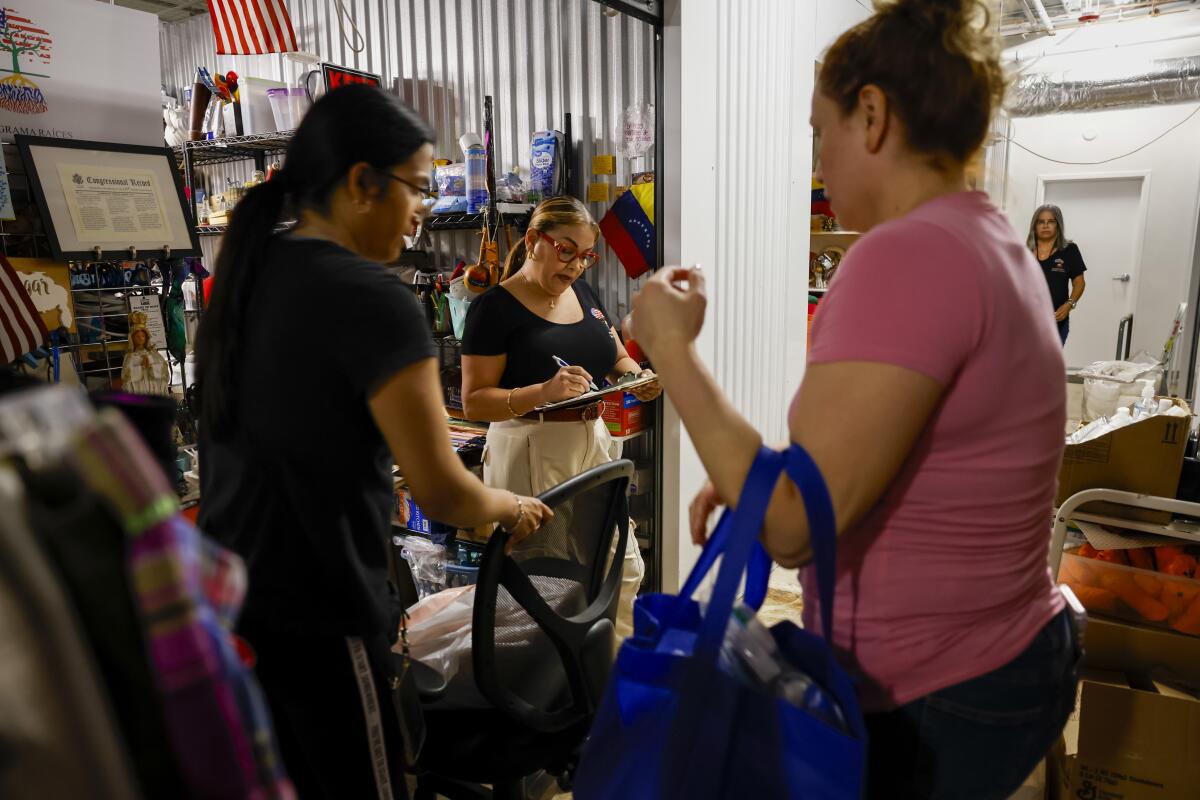
Volunteer help a Venezuelan immigrant at the storage units from a volunteer-run program that distributes donations to recently arrived Venezuelan immigrants in need, in Miami, Fla., in 2023.
(Eva Marie Uzcategui / Los Angeles Times)
One of those programs allowed more than 117,000 Venezuelans to purchase flights directly to the U.S. and stay for two years if they had a U.S.-based financial sponsor and passed a background check. Other Venezuelans entered legally at land ports of entry after scheduling interviews with border officers.
By the end of the Biden administration, more than 600,000 Venezuelans had protection from deportation under Temporary Protected Status, a program used by both Republican and Democratic administrations for immigrants who cannot return home because of armed conflict, natural disaster or other “extraordinary and temporary conditions.”
On the campaign trail, Trump repeatedly referred to Venezuelan immigrants as criminals, singling them out more than any other nationality — in 64% of speeches, an Axios analysis showed. He has said repeatedly, without evidence that Venezuela emptied its prisons and mental institutions to flood the U.S. with immigrants.
One of Trump’s first acts as president was to designate the Venezuelan gang Tren de Aragua as a foreign terrorist organization. Within two months, he invoked an 18th century wartime law, the Alien Enemies Act, to deport 252 Venezuelan men accused of being Tren de Aragua members to El Salvador, where they were imprisoned and tortured despite many having no criminal histories in the U.S. or Latin America.
 ‘Is being gay a crime?’ Venezuelan makeup artist rebuilds life after 125 days in El Salvador prison
A Venezuelan man who was deported from California to El Salvador and held at one of the country’s infamous prisons recounts his months in custody, recalling meager rations and the torture and beating of fellow inmates.
Sept. 11, 2025
Later, the Trump administration stripped away protections for Venezuelans with financial sponsors and TPS, with Homeland Security Secretary Kristi Noem calling the latter “contrary to the national interest.”
Advertisement
In a September Federal Register Notice, Noem said that TPS for Venezuelans undercut the administration’s foreign policy objectives because one result of allowing Venezuelans in the U.S. was “relieving pressure on Maduro’s regime to enact domestic reforms and facilitate safe return conditions.” In other words, if Venezuelans returned home, that would pressure the government to enact reforms.

Secretary of Homeland Security Kristi Noem, along with U.S. Atty. Gen. Pam Bondi, left, and Louisiana Gov. Jeff Landry, right, participates in a news conference near Camp 57 at Angola prison, the Louisiana State Penitentiary and America’s largest maximum-security prison farm, to announce the opening of a new Immigration and Customs Enforcement (ICE) facility that will house immigrants convicted of crimes in West Feliciana Parish, Louisiana, on Sept. 3, 2025.
(Matthew Hilton / AFP via Getty Images)
The administration has offered contrasting assessments of conditions in Venezuela. Noem wrote that although certain adverse conditions continue, “there are notable improvements in several areas such as the economy, public health, and crime.”
Throughout the year, though, the State Department continued to reissue an “extreme danger” travel advisory for Venezuela, urging Americans to leave the country immediately.
Conditions for Venezuelans in the U.S. grew more complicated after a man from Afghanistan was accused of shooting two National Guard members in November; in response, the administration froze the immigration cases of people from 39 countries, including Venezuela, that the administration considers “high-risk.” That means anyone who applied for asylum, a visa, a green card or any other benefit remains in limbo indefinitely.
 Supreme Court says again Trump may cancel temporary protections for Venezuelans granted under Biden
Trump’s lawyers said the new administration had the right to cancel Biden’s temporary protections for immigrants.
Oct. 3, 2025
After a panel of the U.S. 5th Circuit Court of Appeals struck down the Trump administration’s use of the Alien Enemies Act in September, the Justice Department appealed. In a support brief filed in December, the Justice Department cited escalating tensions with Venezuela.
Advertisement
David Smilde, a Tulane University sociologist and expert on Venezuelan politics, said that invading Venezuela could justify renewed use of the Alien Enemies Act.
The law says the president can invoke the Alien Enemies Act not only in times of “declared war,” but also when a foreign government threatens or carries out an “invasion” or “predatory incursion” against the U.S.
“Now it will be difficult, I think, for the court to say, ‘No, you can’t use this,’” Smilde said.
With U.S. officials promising improved conditions in Venezuela and encouraging citizens to return, Smilde said, they could invoke the Alien Enemies Act to quickly deport undocumented immigrants who don’t leave willingly.
“There’s several layers to this,” he said, “and none of it looks very good for Venezuelan immigrants.”
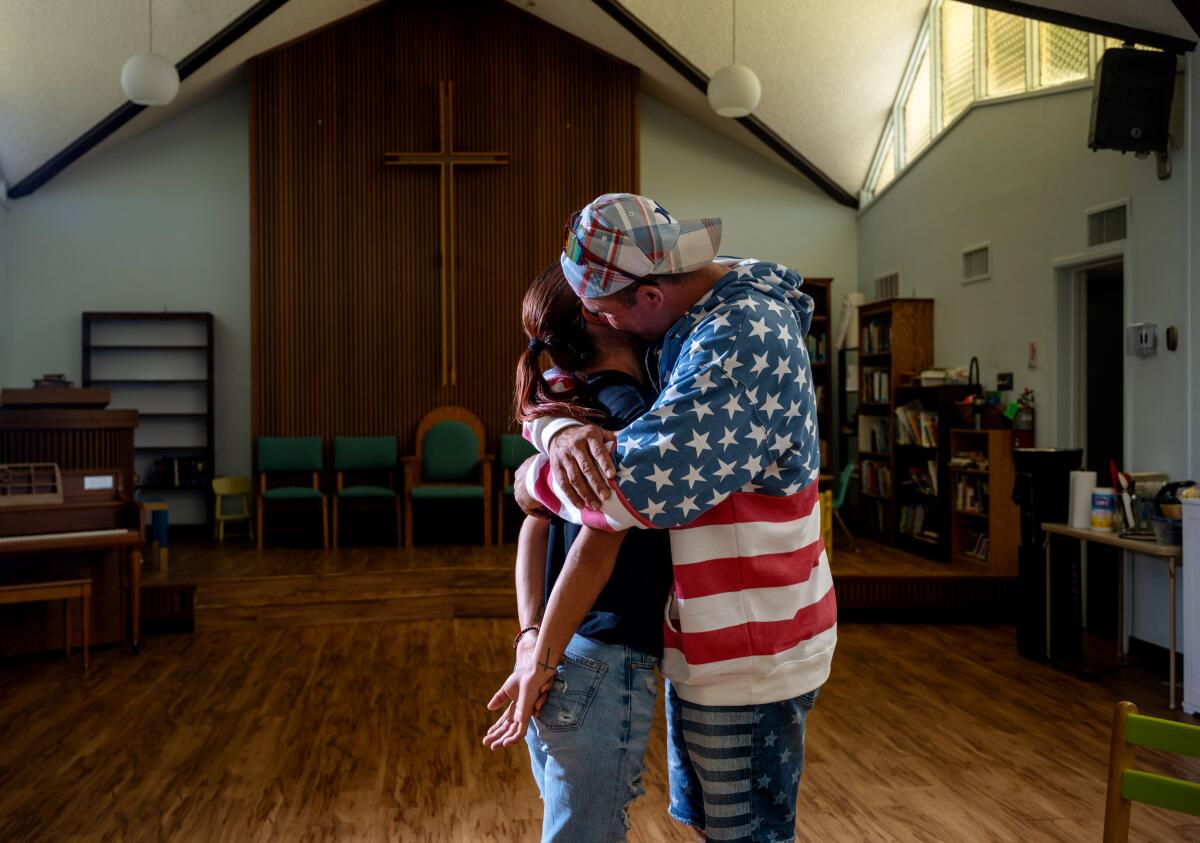
This couple from Venezuela shared their story of why they left their three children back in their home country and spoke of the the experiences of their travel to the United States at the Parkside Community Church in Sacramento on June 16, 2023.
(Jose Luis Villegas / For The Times)
Advertisement
Jose, a 28-year-old Venezuelan living east of Los Angeles, fled Venezuela in 2015 after being imprisoned and beaten for criticizing the government. He lived in Colombia and Peru before illegally crossing the U.S. border in 2022, and now has a pending asylum application. Jose asked to be identified by his middle name out of fear of retaliation by the U.S. government.
The news this week that an ICE agent had shot and killed a woman in Minnesota heightened his anxiety.
“You come here because supposedly this is a country with freedom of expression, and there is more safety, but with this government, now you’re afraid you’ll get killed,” he said. “And that was a U.S. citizen. Imagine what they could do to me?”

People visit a memorial for Renee Nicole Good on Jan. 7 in Minneapolis.
(Scott Olson / Getty Images)
Jose qualifies for a work permit based on his pending asylum, but his application for one is frozen because of the executive order following the National Guard shooting.
The news of Maduro’s arrest was bittersweet, Jose said, because his mother and grandmother didn’t live to witness that day. He said his mother died last year of kidney failure due to lack of medical care, leaving him as the primary breadwinner for his two young sisters who remain in Venezuela with their father, who is disabled.
Advertisement
Still, he said he’s happy with what Trump has done in Venezuela.
“People are saying he’s stealing our petroleum,” he said, “but for 25 years, Cuba, China and Iran have been stealing the petroleum and it didn’t improve our lives.”
Many Venezuelans were encouraged by news that Venezuela would release a “significant number” of political prisoners as a peace gesture.
For Jose, that’s not enough. Venezuela’s government ordered police to search for anyone involved in promoting or supporting the attack by U.S. forces, leading to detentions of journalists and civilians.
“Venezuela remains the same,” he said. “The same disgrace, the same poverty and the same government repression.”
A.G. said she was heartened to hear Noem say Sunday on Fox News that every Venezeulan who had TPS “has the opportunity to apply for refugee status and that evaluation will go forward.” But the administration quickly backtracked and said that was not the case.
Instead, Noem and other administration officials have doubled down on the notion that Venezuelans without permanent lawful status should leave. Noem told Fox News that there are no plans to pause deportation flights despite the political uncertainty in Venezuela.
Advertisement
Tragesser, the U.S. Citizenship and Immigration Services spokesman, said the agency’s posture hasn’t changed.
“USCIS encourages all Venezuelans unlawfully in the U.S. to use the CBP Home app for help with a safe and orderly return to their country,” he said.
More to Read

Voices
Arellano: Citizens are finally getting it: No one’s safe from Trump’s deportation ambitions In Venezuela after Maduro, a common refrain: The oil is ours
Jan. 4, 2026
 To ‘run’ Venezuela, Trump presses existing regime to kneel
Jan. 4, 2026