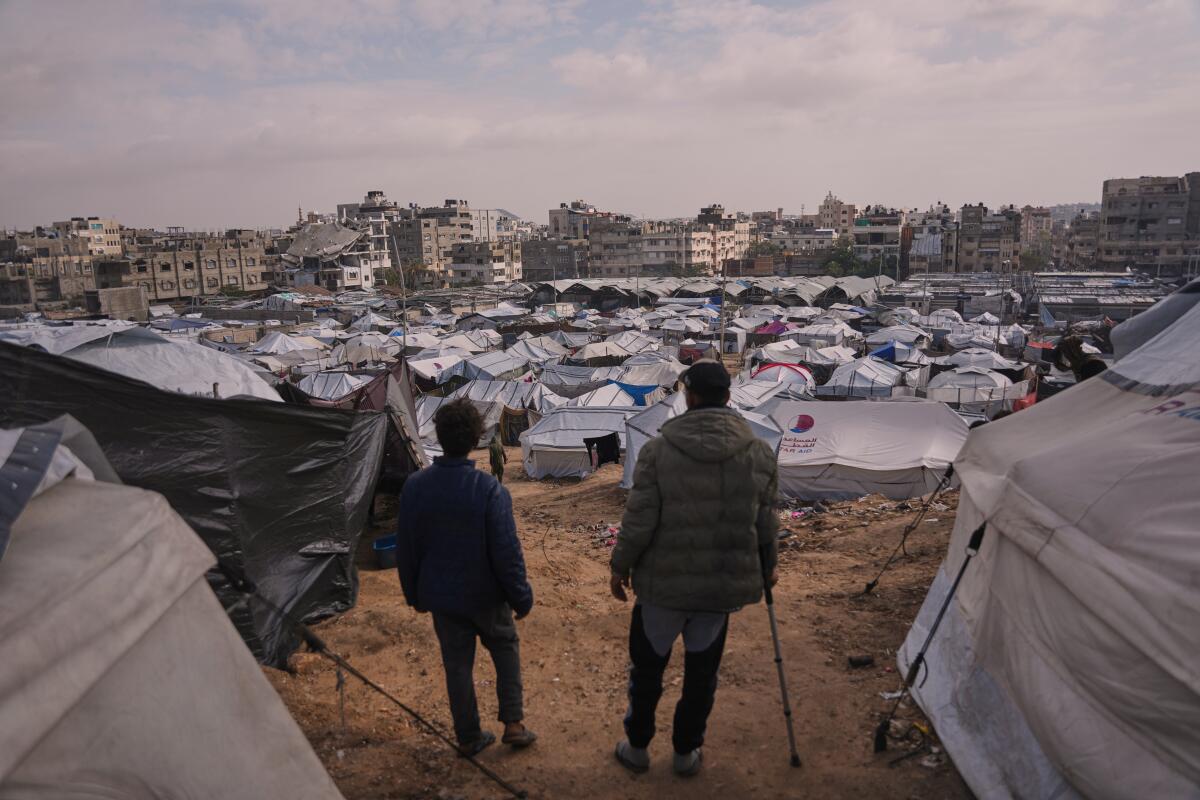
Palestinians look over makeshift tents of a camp for displaced people, set up in an area of Gaza City on Monday.
(Jehad Alshrafi / Associated Press)
By
Nabih BulosForeign Correspondent
Dec. 29, 2025
10:29 AM PT
8 min
Click here to listen to this article
Share via
Close extra sharing options
Email Facebook X LinkedIn Threads Reddit WhatsAppCopy Link URL
Copied!
0:00
0:00
1x
This is read by an automated voice. Please report any issues or inconsistencies here.
The militias first arose as criminal gangs exploiting the security vacuum during the war.
They include members with questionable links to Islamic State.
AMMAN, Jordan — When Israel and Hamas signed a ceasefire earlier this year, it brought into question the fate of militias Israel cultivated during the devastating two-year war as an alternative ruling force in Gaza. Many expected that Hamas — still the dominant force in the Strip — would hunt them down.
Instead, Israel has shifted the militias to the half of Gaza from which it has yet to withdraw, east of the so-called Yellow Line, the military boundary that divides Gaza in two. In the Israeli-controlled half, five factions, still supported by Israel with arms and aid, have established what are essentially tiny fiefdoms, even as they continue to wage a harassment campaign across the Yellow Line to stop Hamas from reasserting its rule.
For its part, Israel wants to use the factions as local proxies to secure parts of the enclave under its control, ensure they’re free of any hostile groups, then set up humanitarian distribution points to keep residents there.
Advertisement
“The objective,” according to a June report on Israeli-supported militias in Gaza from the Institute for National Security Studies in Tel Aviv, “is to sever Hamas’s access to both the local population and to the incoming humanitarian aid.”
 Trump and Netanyahu are to meet in Florida at a crucial moment for the U.S.-backed Gaza ceasefire
The ceasefire between Israel and Hamas that Trump championed has mostly held, but progress has slowed recently. Both sides accuse each other of violations, and divisions have emerged among the U.S., Israel and Arab countries about the path forward.
But the militias, which first arose as criminal gangs exploiting the security vacuum during the war and include members with questionable links to Islamic State, have larger plans: They tout themselves as an integral part of any post-conflict plan.
“After two years of destruction by Hamas, we are the nucleus of a new Gaza, one which will provide a dignified life for Gazan citizens,” said Hussam Al-Astal, the head of one faction called Strike Force Against Terror and which controls a mostly depopulated village southwest of the southern Gazan city of Khan Yunis. He said Israel is working with five different factions operating across the Israeli-controlled parts of the enclave.
Advertisement
He added that he has hundreds of militiamen under his command, contradicting observers who put the total number of fighters across the five groups at around 200.
“Israel is now looking for a peace partner in Gaza,” Al-Astal said. “That’s what we will be.”
The largest of the factions working with Israel is the so-called Popular Forces, which was led until recently by Yasser Abu Shabab, a 32-year-old clansman who was imprisoned twice by Hamas before the war on charges of drug trafficking; and known to have ties to Islamic State in neighboring Sinai. He escaped from a Hamas prison during the war.
Abu Shabab, who was regularly accused by humanitarian groups of looting aid trucks, was assassinated earlier this month by disgruntled members of his militia, according to a statement from Abu Shabab’s clan.
He was soon replaced by his deputy, Ghassan Al-Duhini, 39, a no less controversial figure who once served as a security officer with the Palestinian Authority in Gaza, then left it to join Jaysh al-Islam, a Gaza-based armed faction that pledged allegiance to Islamic State in 2015.
Al-Duhini reportedly coordinated smuggling with militant groups in the Sinai. He too was arrested twice by Hamas before the war and escaped when it began.
Advertisement
Since the ceasefire, Israel has been working through the Popular Forces as its proxy in Rafah, the southernmost city in the Gaza Strip a that was all but destroyed during the war and razed by Israeli forces.
The city now lies mostly empty. But the U.S.-led Civilian-Military Coordination Center (the body that is supposed to monitor the ceasefire, coordinate aid deliveries and start reconstruction in the enclave) is considering Rafah as a pilot for a Hamas-free, so-called “alternative safe community of some 10,000 to 15,000 people, according to a United Nations official and an aid worker who refused to be named to be able to speak freely.
Israeli Prime Minister Benjamin Netanyahu was visiting Mar-a-Lago on Monday, where he was meeting with President Trump and a raft of U.S. officials, including Secretary of State Marco Rubio, with whom Netanyahu said on X he had “a great meeting.”
Netanyahu was set to discuss implementing the second phase of the ceasefire, which calls for an interim authority to govern the Gaza Strip, along with an International Stabilization Force (ISF) that would deploy in Israel’s stead. Both points are problematic for Israel, which has been reluctant to continue onto the second phase without seeing Hamas disarm.
Plans call for Gaza to be governed by a Trump-led Board of Peace, which would also oversee rebuilding the Gaza Strip for its 2.1 million people. But Jared Kushner, Trump’s son-in-law and one of the driving forces behind the ceasefire deal in October, has said some reconstruction could begin in Rafah.
If that happens, said the aid worker, it would mean “the U.S. will be cooperating with an ISIS-aligned security force.”
Advertisement
Of Al-Duhini, the aid worker said, “There are so many other, better partners in Gaza than this guy.”
In a recent propaganda video released by the group, Al-Duhini is shown addressing a group of gunmen, telling them they are working as part of the Trump-led Board of Peace and the International Stabilization Force that are meant to monitor the ceasefire.
“We will sweep through Rafah one grain of a sand at a time,” he says, to remove “terrorism” and allow civilians to return to the area. “We want to establish a safe community.”
What that has meant in practice, according to analysts and people living in areas under the Popular Forces’ control, is a heavy security hand, with militiamen regularly confiscating and inspecting people’s phones, preventing them from communicating with anyone in Hamas-controlled areas, and searching homes.
“They’re treating them like prisoners,” said Muhammad Shehada, a Gaza expert at the European Council on Foreign Relations. He added that Israel had given the factions capture-or-kill lists for various Hamas members in Gaza and was supervising interrogations.
Meanwhile, the militias have also conducted hit-and-run operations against Hamas operatives, killing a number of them when the opportunity arises; the Popular Forces said in June they had killed 50 Hamas members.
Advertisement
On Monday, Hamas confirmed the death of a number of its top commanders in strikes by Israel during the last year.
The leaders killed included Muhammad Sinwar, the head of its military wing the Qassam Brigade, the head of manufacturing and chief-of-staff. Also killed was Abu Ubaida, the masked spokesman last seen in a September speech; the group identified him as Huthaifa Al-Kahlout. Israel previously disclosed his identity in 2023.
 Trump is leaning on son-in-law Jared Kushner for difficult diplomacy
President Trump’s son-in-law Jared Kushner has been drawn back into the foreign policy fold and is taking a greater role in delicate peace negotiations.
Dec. 22, 2025
The groups have also acted on Israel’s behalf: Last week, a faction called the Popular Defense Army, based near Gaza City, shot at people’s homes in a neighborhood east of the city, forcing residents to leave. Observers said this was aimed at allowing Israel to shift the Yellow Line westward. (The Yellow Line’s location was specified during the ceasefire, but Israel has continued to shift it westward.)
According to Al-Astal, the five militias plan to unite their efforts soon with the establishment of a military council, which he says could act as a transitional government for the moment Hamas falls. He said international recognition would help.
There are indications of support beyond Israel. Popular Forces fighters have appeared with vehicles with markings from the United Arab Emirates, and some of the factions claim they are affiliated peripherally with the Palestinian Authority. The Palestinian Authority denied any links.
“We’re hoping to have better things coming, and that our presence will expand,” he said. He added that once this happens, he expects people in Hamas-held areas to shift eastward to the militias’ control.
Advertisement
“I’m telling you, if the way before them was open, there wouldn’t be a single person left in those parts of Gaza under Hamas except for just a few Hamas fighters,” he said.
More to Read
 Many unresolved questions remain as a ceasefire holds in Gaza
Oct. 11, 2025
 News Analysis: Why the Gaza ceasefire puts both Netanyahu and Hamas at political risk
Oct. 10, 2025
 Thousands of Palestinians return to what’s left of their homes as Gaza ceasefire takes effect
Oct. 10, 2025