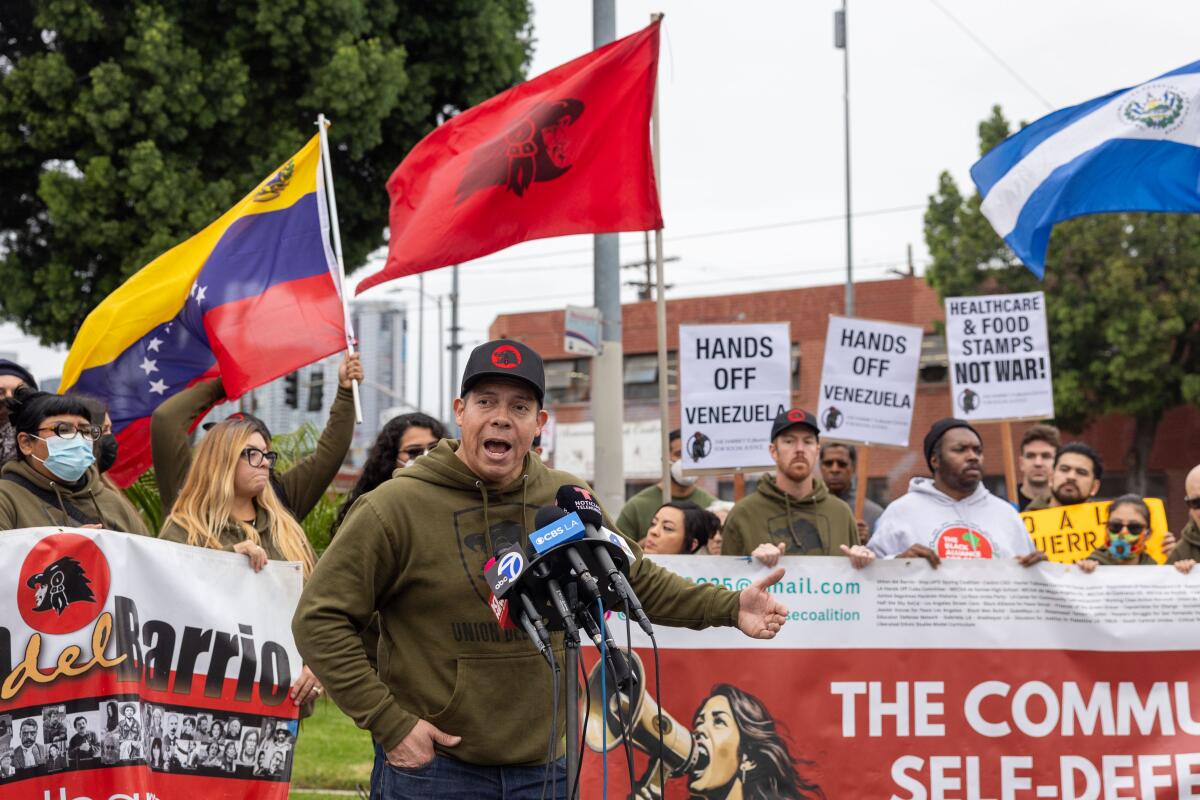
Union del Barrio member Ron Gochez speaks during a Union del Barrio “U.S. out of Venezuela” news conference Saturday in Los Angeles.
(Ronaldo Bolanos / Los Angeles Times)
By
Andrea Castilloand
Matthew OrmsethJan. 3, 2026
3:23 PM PT
8 min
Click here to listen to this article
Share via
Close extra sharing options
Email Facebook X LinkedIn Threads Reddit WhatsAppCopy Link URL
Copied!
0:00
0:00
1x
This is read by an automated voice. Please report any issues or inconsistencies here.
The U.S. capture of Nicolás Maduro sparked celebrations among many Venezuelan Americans in South Florida and Los Angeles.
Some protesters in Los Angeles opposed the military action.
Venezuelan Americans express conflicting feelings, grateful for Maduro’s capture but wary of President Trump’s U.S. intervention.
WASHINGTON — Maria Eugenia Torres Ramirez was having dinner with her family in Los Angeles on Friday night when the flood of messages began. Word had begun to circulate that the U.S. was invading Venezuela and would seize its president, Nicolás Maduro.
Torres Ramirez, 38, fled her native country in 2021, settled in L.A. and has a pending application for asylum. Her family is scattered throughout the world — Colombia, Chile and France. Since her parents died, none of her loved ones remain in Venezuela.
Still, news that the autocrat who separated them had been captured delivered a sense of long-awaited elation and united the siblings and cousins across continents for a rare four-hour phone call as the night unfolded.
Advertisement
“I waited for this moment for so long from within Venezuela, and now that I’m out, it’s like watching a movie,” said Torres Ramirez, a former political activist who opposed Maduro. “It’s like a jolt of relief.”
Many Venezuelans across the U.S. celebrated the military action that resulted in Maduro’s arrest. Economic collapse and political repression led roughly 8 million Venezuelans to emigrate since 2014, making it one of the world’s largest displacement crises.
 Trump says U.S. will ‘run’ Venezuela after capturing Maduro in audacious attack
Trump offered few details about how the U.S. plans to run Venezuela, saying only that he intends to designate ‘a group’ from his administration to oversee the eventual transition of power.
About 770,000 live in the U.S. as of 2023, concentrated mainly in the regions of Miami, Orlando, Houston and New York. Just over 9,500 live in L.A., according to a 2024 U.S. Census estimate.
Advertisement
In the South Florida city of Doral, home to the largest Venezuelan American community, residents poured into the streets Saturday morning, carrying the Venezuelan flag, singing together and praising the military action as an act of freedom.
In Los Angeles, a different picture emerged as groups opposed to Maduro’s arrest took to the streets, though none identified themselves as being of Venezuelan descent. At a rally of about 40 people south of downtown Los Angeles, John Parker, a representative of the Harriet Tubman Center for Social Justice, called the raid a “brutal assault and kidnapping” that amounted to a war crime.
The United States’ intervention in Venezuela had nothing to do with stopping the flow of drugs, he said, and everything to do with undermining a legitimate socialist government. Parker called for Maduro to be set free as a few dozen protesters behind him chanted, “Hands off Venezuela.”
Parker said when he visited Venezuela a few weeks ago as part of a U.S. peacemaking delegation, he saw “the love people had for Maduro.”
 What we know about a US strike that captured Venezuela’s Maduro
The United States has carried out a military strike on Venezuela, capturing President Nicolás Maduro and his wife, Cilia Flores
Jan. 3, 2026
A later demonstration in Pershing Square drew hundreds out in the rain to protest the U.S intervention. But when a speaker led chants of “No war in Venezuela,” a woman draped in a Venezuelan flag attempted to approach him and speak into the microphone. A phalanx of demonstrators circled her and shuttled her away.
At Mi Venezuela, a restaurant in Vernon, 16-year-old Paola Moleiro and her family ordered empanadas Saturday morning.
Advertisement
A portion of one of the restaurant’s walls was covered in Venezuelan bank notes scrawled with messages. One read: “3 de enero del 2026. Venezuela quedo libre.”
Venezuela is free.
Around midnight the night before, Paola started getting messages on WhatsApp from her relatives in Venezuela. The power was out, they said, and they forwarded videos of what sounded like bomb blasts.
Paola was terrified. She’d left Venezuela at age 7 with her parents and siblings, first for Panama and later the U.S., in 2023. But the rest of her family remained in Venezuela, and she had no idea what was going on.
Paola and her family stayed up scanning television channels for some idea of what was happening. Around 1:30 a.m., President Trump announced that U.S. forces had captured Maduro.
“The first thing I did, I called my aunt and said, ‘We are going to see each other again,’” she said.

Voices
Hiltzik: What does Trump have against Venezuela? His explanations keep changingIs it oil, drugs, immigrants or politics? President Trump’s explanations of his animosity for Venezuela are hard to keep straight.
Dec. 23, 2025
Because of the Venezuelan state’s control over media, her relatives had no idea their leader had been seized by U.S. forces. “Are you telling me the truth?” Paola said her aunt asked.
Paola hasn’t been home in nine years. She misses her grandmother and her grandmother’s cooking, especially her caraotas negras, or black beans. As a child, she said, certain foods were so scarce that she had an apple for the first time only after moving to Panama.
Advertisement
Paola said she was grateful to Trump for ending decades of authoritarian rule that had reduced her home country to a shell of what it once was.
“Venezuela has always prayed for this,” she said. “It’s been 30 years. I feel it was in God’s hands last night.”
For Torres Ramirez, it was difficult to square her appreciation for Trump’s accomplishment in Venezuela with the fear she has felt as an immigrant under his presidency.
“It’s like a double-edged sword,” she said. “Throughout the course of this whole year, I have felt persecuted. I had to face ICE — I had to go to my appointment with the fear that I could lose it all because the immigration policies had changed and there was complete uncertainty. For a moment, I felt as if I was in Venezuela. I felt persecuted right here.”
During a news conference Saturday morning, Trump said Maduro was responsible for trafficking illicit drugs into the U.S. and the deaths of thousands of Americans. He repeated a baseless claim that the Maduro government had emptied Venezuela’s prisons and mental institutions and “sent their worst and most violent monsters into the United States to steal American lives.”
“They sent everybody bad into the United States, but no longer, and we have now a border where nobody gets through,” he said.
Advertisement
Trump also announced that the U.S. will “run” Venezuela and its vast oil reserves.
“We’ll run it professionally,” he said. “We’ll have the greatest oil companies in the world go in and invest billions and billions of dollars and take that money, use that money in Venezuela, and the biggest beneficiary are going to be the people of Venezuela.”
Torres Ramirez said that while she’s happy about Maduro’s ouster, she’s unsure how to feel about Trump’s announcement saying the U.S. will take over Venezuela’s oil industry. Perhaps it won’t be favorable in the long term for Venezuela’s economy, she said, but the U.S. intervention is a win for the country’s political future if it means people can return home.
Patricia Andrade, 63, who runs Raíces Venezolanas, a volunteer program in Miami that distributes donations to Venezuelan immigrants, said she believes the Trump administration is making the right move by remaining involved until there is a transition of power.
Andrade, a longtime U.S. citizen, said she hasn’t been to Venezuela in 25 years — even missing the deaths of both parents. She said she was accused of treason for denouncing the imprisonment of political opponents and the degradation of Venezuela’s democracy under Maduro’s predecessor Hugo Chavez. She said she worries that Venezuela’s remaining political prisoners could be killed as payback for Maduro’s arrest.
“We tried everything — elections, marches, more elections ... and it couldn’t be done,” she said. “Maduro was getting worse and worse, there was more repression. If they hadn’t removed him, we were never going to recover Venezuela.”
While she doesn’t want the U.S. to fix the problems of other countries, she thanked Trump for U.S. involvement in Venezuela.
Advertisement
She said she can’t wait to visit her remaining family members there.
More to Read
 U.S. capture of Maduro in Venezuela criticized as violation of international, U.S. law
  A timeline of the US military’s buildup and strikes against Venezuela leading to Maduro’s capture
Jan. 3, 2026
 Maduro approaches his last act as Venezuela’s autocratic leader
Jan. 3, 2026