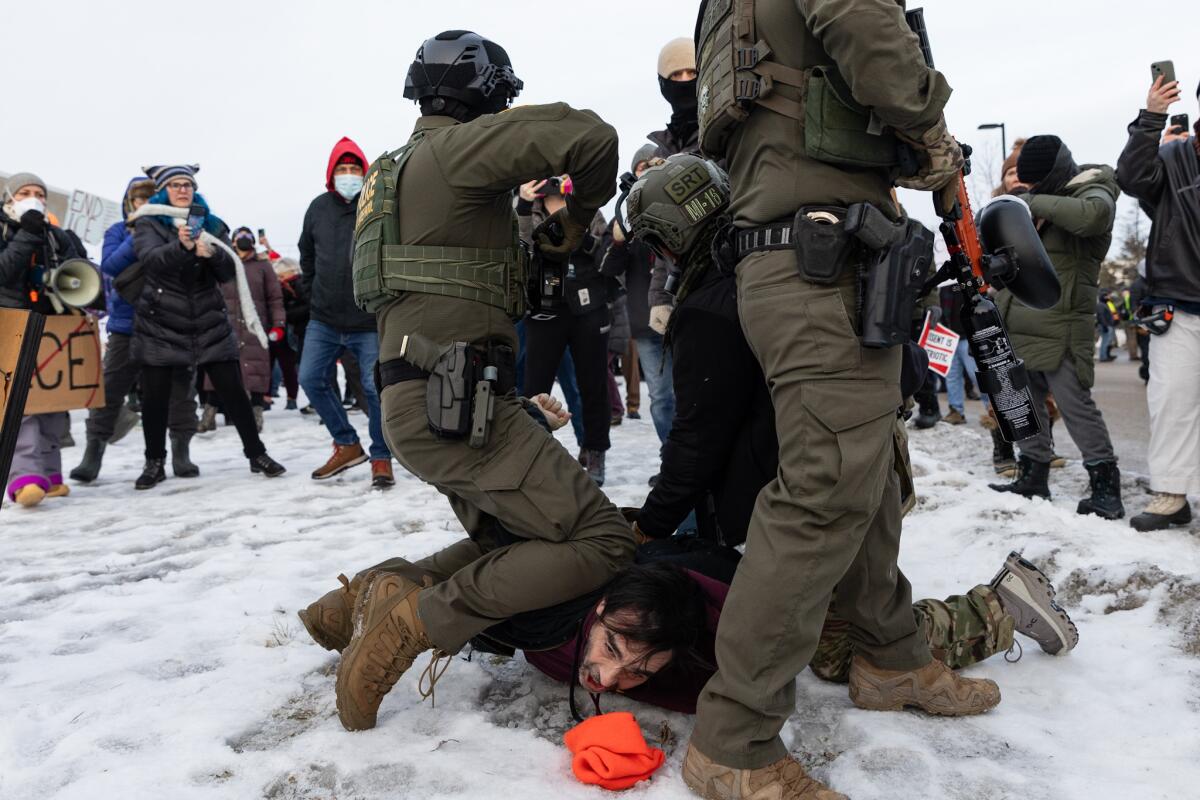
Protesters clash with law enforcement outside an Immigration and Customs Enforcement (ICE) facility as they attempt to block federal agents vehicles from leaving during a protest against ICE following the fatal shooting of a 37-year-old woman by a U.S. immigration agent, in Minneapolis, on Thursday.
(Mostafa Bassim / Anadolu via Getty Images)

By
Itzel LunaStaff Writer
ContactJan. 8, 2026
1:06 PM PT
8 min
Click here to listen to this article
Share via
Close extra sharing options
Email Facebook X LinkedIn Threads Reddit WhatsAppCopy Link URL
Copied!
0:00
0:00
1x
This is read by an automated voice. Please report any issues or inconsistencies here.
It was the type of standoff that has become routine since the Trump Administration launched its immigration crackdown in June: unmarked federal vehicles, sirens blaring, move toward a maroon SUV stopped crosswise in the middle of a residential road in Minneapolis. Bystander video shows the driver seeming to wave them by, as one of the vehicles passes and two immigration agents approach her car on foot.
“Get out of the f— car,” one of the them yells and yanks at the door handle. The driver backs up to straighten the car out, and then turns right and drives forward, as a third agent at the front left corner of the vehicle draws his gun and shoots three times at close range, the video shows.
The car lunges forward and strikes another vehicle down the street. The driver, Renee Nicole Good, a 37-year-old mother of three, is dead.
Advertisement
The shooting on Wednesday is the latest in a number of incidents around the country in which agents have fired on drivers they later alleged were using their vehicles as weapons.
“This doesn’t surprise me and until something changes dramatically this probably, and I say this sadly, won’t be the last tragic incident involving ICE and protesters,” said Jim Bueermann, founder and president of the Future Policing Institute.
Increasing immigration enforcement operations nationwide, coupled with lack of uniformed training for agents and a disconnect between federal operations and local coordination means more armed confrontations are likely, Bueermann said.
Advertisement
Kristi Noem, the secretary of Homeland Security, said the officer opened fire in Minneapolis because he feared for his life during “an act of domestic terrorism.” She said Good had “proceeded to weaponize her vehicle and she attempted to run a law enforcement officer over.”
But the video shows that the agent was not in the path of the vehicle as he fired, which has sparked nationwide outrage, including in California where protesters took to the streets Wednesday night. State lawmakers were quick to condemn the shooting, which Assemblymember Mark González (D-Los Angeles) called a “public execution.”
The tactics in Minnesota mirror those agents have taken in Southern California, said Cynthia Santiago, a Los Angeles-based attorney, who is representing a man shot by immigration agents in Ontario.
“This happened over there, but I’m looking at videos in our different communities...across Southern California where people are continuously being stopped, broken windows and taken out of their car,” Santiago said.

A bullet hole is seen in the windshield as law enforcement officers attend to the scene of the shooting involving federal law enforcement agents, Wednesday, Jan. 7, 2026, in Minneapolis.
(Tom Baker / Associated Press)
When an immigration agent shot Carlitos Ricardo Parias in Los Angeles in late October, DHS alleged the popular TikTok streamer had “weaponized” his car and rammed into an agent’s vehicle to evade arrest.
Advertisement
Body camera footage that came out over two months later told a different story. Parias is seen raising his hands in the air and repeatedly asking why he was stopped. His car is pinned by federal vehicles and does not move before the agent shoots him. Federal prosecutors dismissed charges against Parias shortly after the video was released.
A little over a week after Parias was shot, Carlos Jimenez, a food bank worker, approached agents conducting an operation at a bus stop in Ontario to warn them that school children would be there soon, his attorneys said in an interview in November.
“He was telling them, ‘Excuse me. Can you guys please, you know, please wrap this up.’ And immediately, the masked agent pulls out a gun and exchanges some words,” said Santiago. “[The agent is] also shaking his pepper spray.”
“He’s in fear, and he’s trying to get out of the situation,” she said. His car was partially blocked by the agents’ vehicles.
“He had to reverse to get away,” said attorney Robert Simon.
An agent shot him in the back of the shoulder through the back passenger window.
No video of the shooting has surfaced yet.
Tricia McLaughlin, a spokesperson for the Department of Homeland Security, said at the time that Jimenez had “attempted to run officers over by reversing directly at them without stopping” and that the shots were “defensive.”
Jimenez, 25, pleaded not guilty to assault against a federal officer in November, and was released on bond.
Advertisement
Marimar Martinez, 30, faced similar allegations in Chicago after an immigration agent shot her five times during a traffic altercation in August. The Department of Homeland security said she “ambushed” agents by ramming their vehicle. The U.S. Attorney dropped the charges in November.
“The same thing is going to continue to happen as you continue to put these agents that are trained to operate at the border to enforce immigration laws, and drop them into U.S. cities that they’re not from, and put them in situations that they’re not ready for,” said Christopher Parente, Martinez’s attorney.
An undocumented immigrant was shot and killed at close range by an immigration agent in Chicago in September. The Trump Administration said Silverio Villegas-Gonzalez had driven his vehicle at agents, dragging one along and causing severe injuries. But on body cam video, the agent said the injuries were “nothing major.”
In San Bernardino in August, Francisco Longoria was driving his truck when a U.S. Customs and Border Patrol officer shot at him in August. Department of Homeland Security officials have said officers were injured during the encounter when Longoria tried to “run them down.”
Longoria’s attorneys said he feared for his safety and was trying to get away after masked officers shattered his car window.
(In a non-vehicle incident, Keith Porter, a father of two, was shot to death by an off-duty immigration agent at a Northridge apartment complex on New Years Eve. DHS claims the agent was responding to an active shooter, but Porter’s family said he was shooting a gun into the air.)
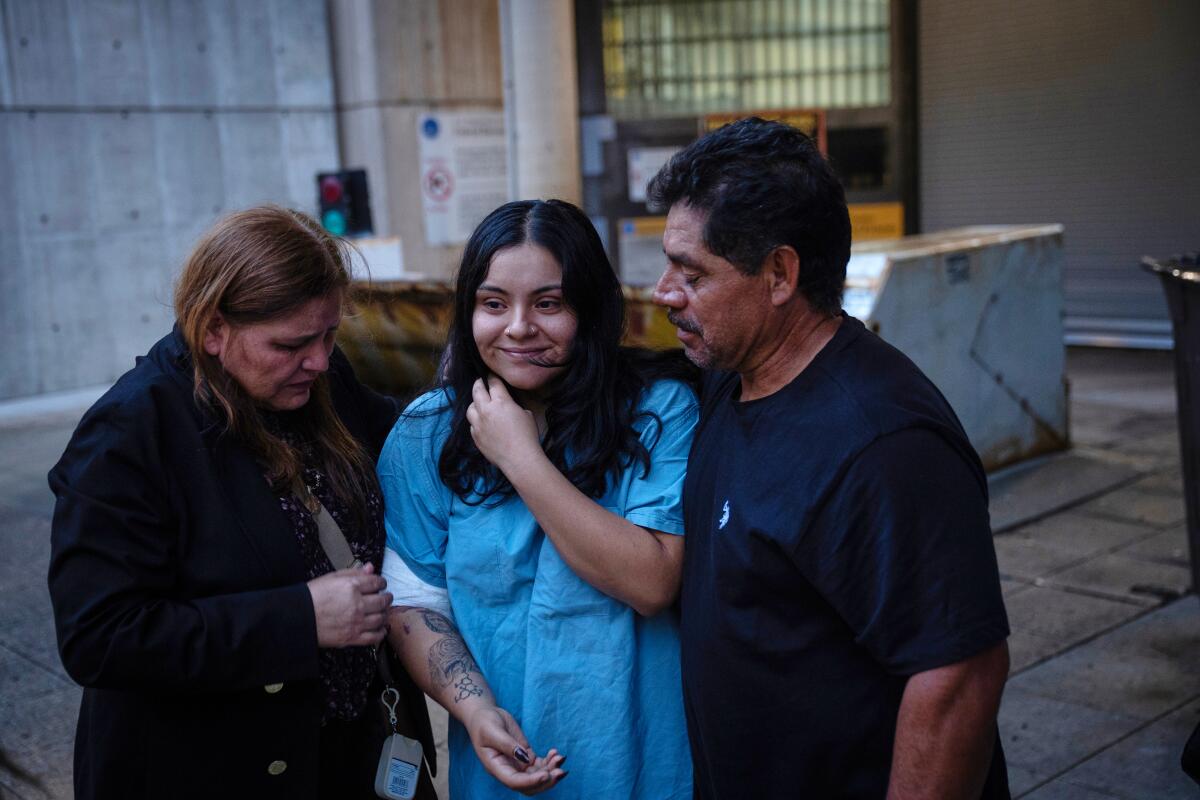
Marimar Martinez, center, is greeted by her family after being released from the Metropolitan Correctional Center on Oct. 6, 2025, after being shot by immigration agents and charged with assaulting federal officers in an incident in Chicago’s Brighton Park.
(E. Jason Wambsgans / Chicago Tribune via Associated Press)
Advertisement
The shooting in Minneapolis occurred only a day after DHS unleashed what ICE director Todd Lyons called the “largest operation ever” in Minnesota. The Trump administration had just deployed over 2,000 agents to the state.
Immigration agents were carrying out targeted operations Wednesday morning when they were blocked by protesters, said DHS spokesperson Tricia McLaughlin. In the hours following the Good’s death, diverging accounts quickly emerged.
McLaughlin claimed shortly after the shooting that Good had committed an act of domestic terrorism, stating that she had “weaponized her vehicle” and attempted to kill officers.
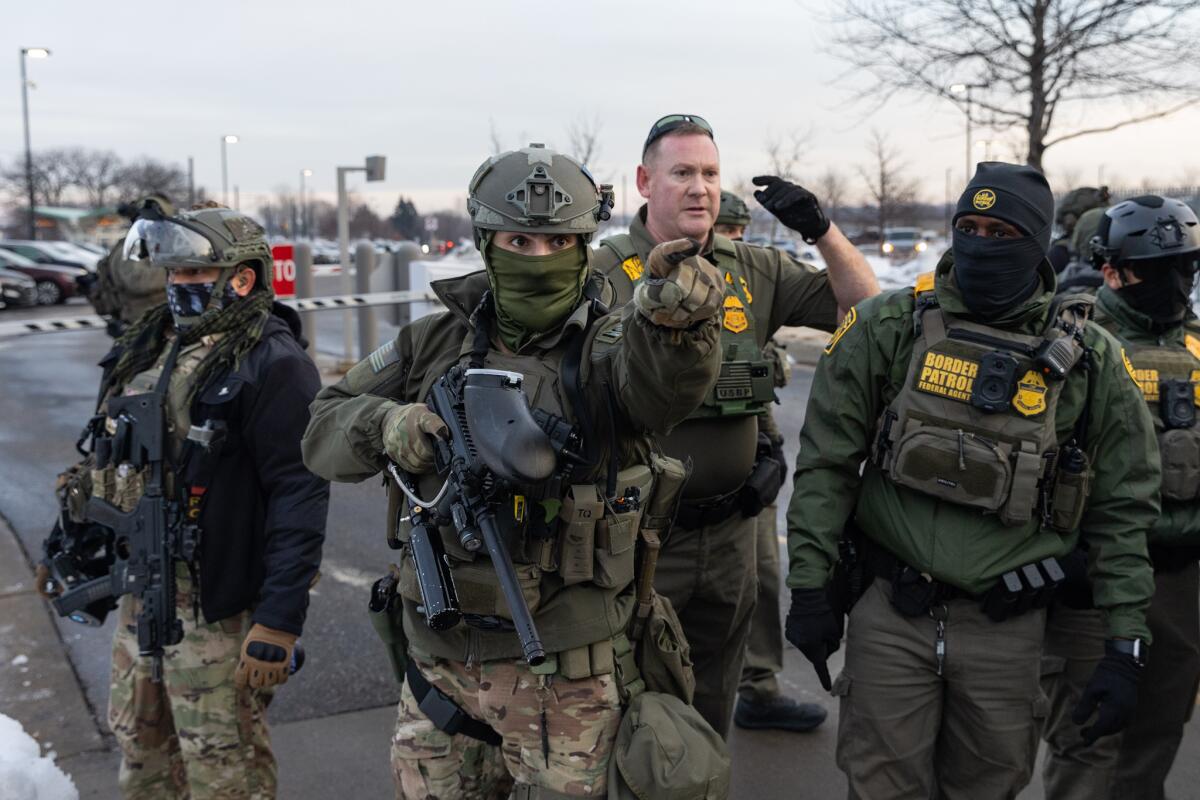
Federal agents push back as protesters gather at an ICE facility following the fatal shooting of a 37-year-old woman by a U.S. immigration agent yesterday, in Minneapolis on January 8, 2026.
(Mostafa Bassim / Anadolu via Getty Images)
Minneapolis Mayor Jacob Frey rejected the DHS’s claims that the ICE agent acted in self-defense and called for ICE to leave the city.
“People are being hurt. Families are being ripped apart,” Frey said during a press conference Wednesday. “Long-term Minneapolis residents that have contributed so greatly to our city, to our culture, to our economy, are being terrorized and now somebody is dead. That’s on you, and it’s also on you to leave.”
Advertisement
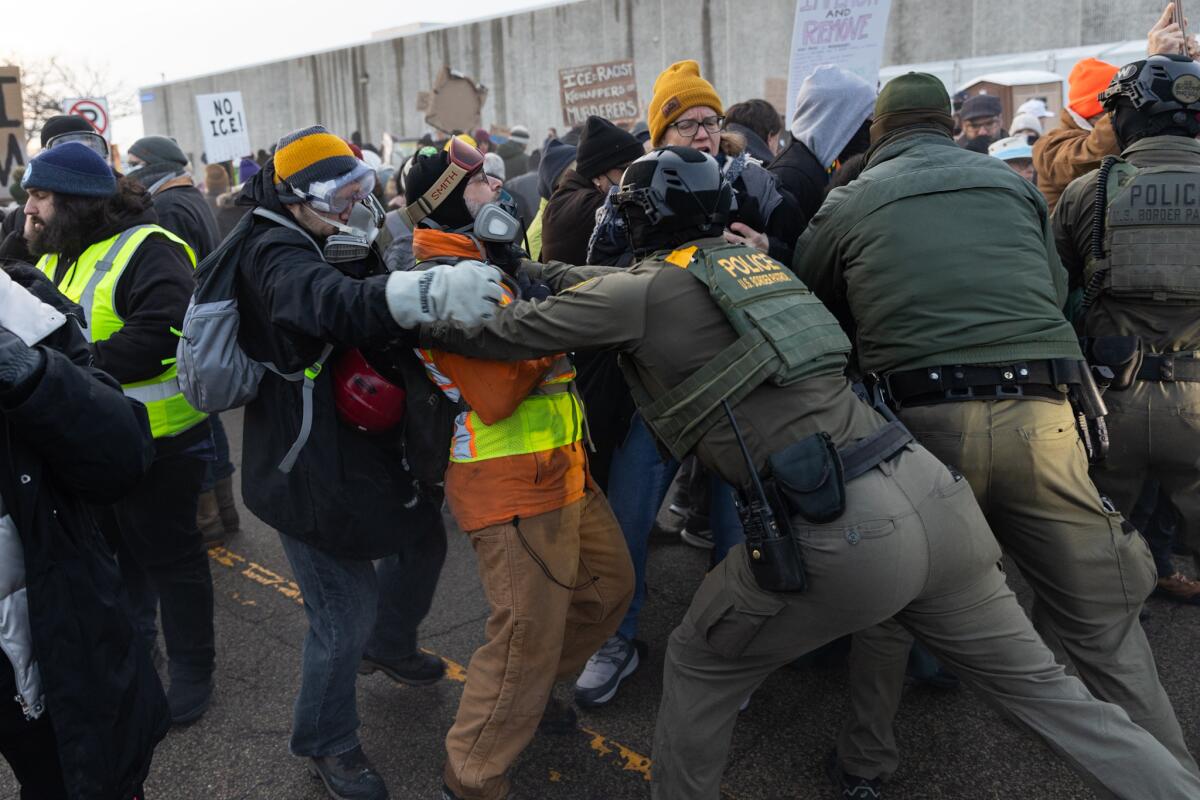
Protesters clash with law enforcement outside an Immigration and Customs Enforcement (ICE) facility as they attempt to block federal agentsa vehicles from leaving during a protest against ICE following the fatal shooting of a 37-year-old woman by a U.S. immigration agent, in Minneapolis, United States, on January 8, 2026.
(Mostafa Bassim / Anadolu via Getty Images)
A clear picture of what transpired likely won’t be available until investigations are completed, Bueermann said.
“Everybody wants to know the answer right now, and that’s just that’s not possible,” he said. “All of this confusion, where both accounts are right and wrong at the same time...it’s going to take a while for somebody to determine that.”
Parente said his client, Martinez, who survived the five gunshots and was exonerated, was horrified, but not surprised following Wednesday’s shooting.
“It’s heartbreaking for her to see this, but thankfully, she’s alive to see it,” Parente said. “Unfortunately, you’re going to see more and more rounds fired by these agents towards us, citizens and people that reside in these cities.”
More to Read
 Minneapolis protesters vent their outrage after an ICE officer kills a woman
Jan. 8, 2026
 ‘Active shooter’ or ICE agent’s victim? What happened in L.A. New Year’s Eve killing?
Jan. 8, 2026
 A deadly Minneapolis shooting puts the White House on defense