
Donald Trump arrived back in the Oval Office bearing a trunkload of gilded decor and a sheaf of policies that have drastically transformed America over the last 12 months.
(Alex Brandon / Associated Press)


By
Anita Chabriaand
Mark Z. BarabakDec. 28, 2025
3 AM PT
9 min
Click here to listen to this article
Share via
Close extra sharing options
Email Facebook X LinkedIn Threads Reddit WhatsAppCopy Link URL
Copied!
0:00
0:00
1x
This is read by an automated voice. Please report any issues or inconsistencies here.
Is there a dumpster somewhere to torch and bury this year of bedlam, 2025?
We near its end with equal amounts relief and trepidation. Surely we can’t be expected to endure another such tumultuous turn around the sun?
It was only January that Donald Trump moved back into the White House, apparently toting trunkloads of gilt for the walls. Within weeks, he’d declared an emergency at the border; set in motion plans to dismantle government agencies; fired masses of federal workers; and tariffs, tariffs, tariffs.

Demonstrators at a No Kings rally in Washington, protesting actions by President Trump and Elon Musk.
(Jose Luis Magana / Associated Press)
By spring, the administration was attacking Harvard as a test case for strong-arming higher education. By June, Trump’s grotesquely misnamed Big Beautiful Bill had become law, giving $1 trillion in tax cuts to billionaires and funding a deportation effort (and armed force) that has fundamentally reshaped American immigration law and ended any pretense about targeting “the worst of the worst.”
Fall and winter have brought questionable bombings of boats in the Caribbean, a further backing away from Ukraine, a crackdown on opposition to Trump by classifying it as leftist terrorism and congressional inaction on healthcare that will leave many struggling to stay insured.
That’s the short list.

Voices
Chabria: For undocumented immigrants, a posada offers a moment of safety and comfortThe posada was a moment of hope and happiness amid turmoil, and a reminder that not all law enforcement officers see immigration status as a measure of worth.
Dec. 24, 2025
It was a year when America tried something new, and while adherents of the MAGA movement may celebrate much of it, our columnists Anita Chabria and Mark Z. Barabak have a different perspective.
Advertisement
Here, they renew their annual tradition of looking at the year past and offering some thoughts on what the new year may bring.
Chabria: Welp, that was something. I can’t say 2025 was a stellar year for the American experiment, but it certainly will make the history books.
Before we dive into pure politics, I’ll start with something positive. I met a married couple at a No Kings rally in Sacramento who were dressed up as dinosaurs, inspired by the Portland Frog, an activist who wears an inflatable amphibian suit.
Advertisement
When I asked why, the husband told me, “If you don’t do something soon, you will have democracy be extinct.”
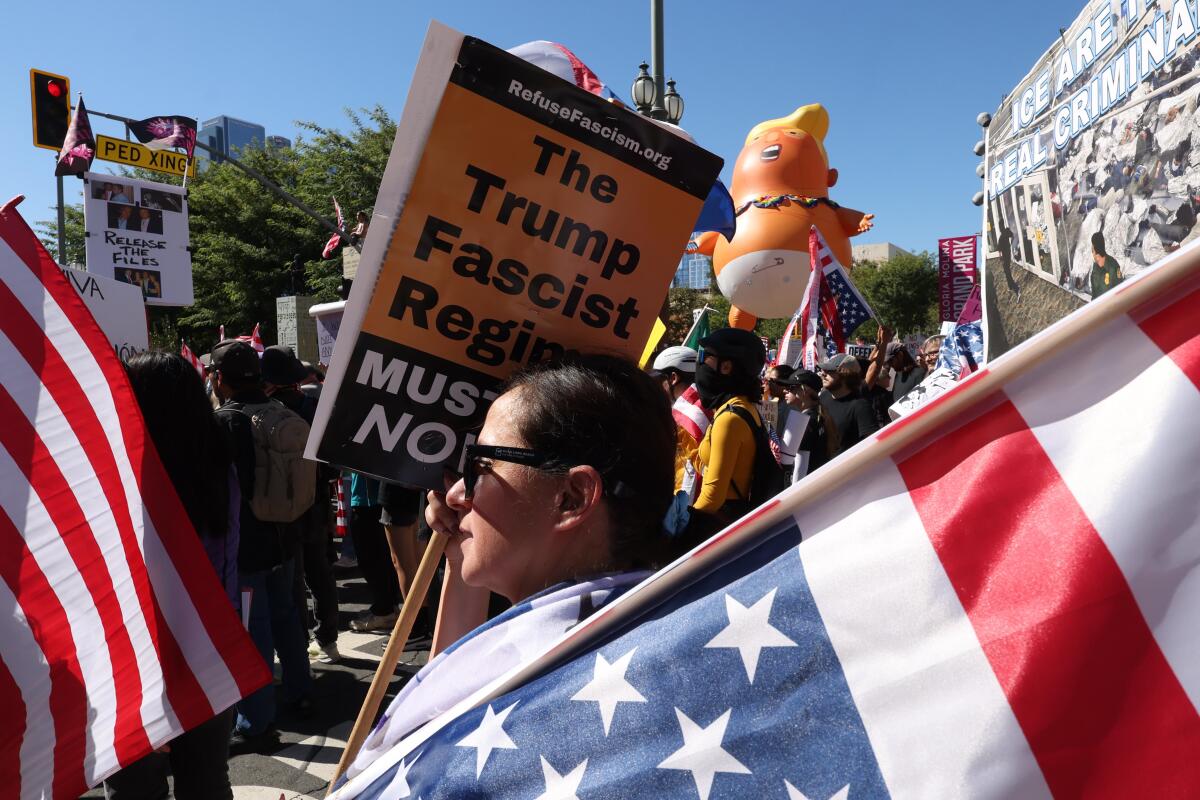
Crowds participate in No Kings Day in downtown Los Angeles in October.
(Genaro Molina / Los Angeles Times)
I loved that so many Americans were doing something by turning out to not just protest policies that hit personally, but to rally in support of democracy writ large. For many, it was their first time taking this kind of action, and they were doing it in a way that expressed optimism and possibility rather than giving in to anger or despair. Where there is humor, there is hope.
Barabak: As in, it only hurts when I laugh?
In 2024, a plurality of Americans voted to reinstall Trump in the White House — warts, felony conviction and all — mainly in the hope he would bring down the cost of living and make eggs and gasoline affordable again.
While eggs and gas are no longer exorbitant, the cost of just about everything else continues to climb. Or, in the case of beef, utility bills and insurance, skyrocket.

The John F. Kennedy Memorial Center for the Performing Arts is another of the long-standing institutions Trump has smeared his name across.
(Jacquelyn Martin / Associated Press)
Meantime, the president seems less concerned with improving voters’ lives than smearing his name on every object he lays his eyes on, one of the latest examples being the John F. Kennedy Center for the Performing Arts.
(The only place Trump doesn’t want to see his name is in those voluminous Epstein files.)
Advertisement
I wonder: Why stop there? Why not brand these the United States of Trump-erica, then boast we live in the “hottest” country on Planet Trump?
Chabria: Stop giving him ideas!
You and I agree that it’s been a difficult year full of absurdity, but we’ve disagreed on how seriously to take Trump as a threat to democracy. As the year closes, I am more concerned than ever.
It’s not the ugly antics of ego that alarm me, but the devastating policies that will be hard to undo — if we get the chance to undo them.
The race-based witch hunt of deportations is obviously at the top of that list, but the demolition of both K-12 and higher education; the dismantling of federal agencies, thereby cutting our scientific power as a nation; the increasing oligarchy of tech industrialists; the quiet placement of election deniers in key election posts — these are all hammers bashing away at our democracy.
Now, we are seeing overt antisemitism and racism on the MAGA right, with alarming acceptance from many. The far right has championed a debate as dumb as it is frightening, about “heritage” Americans being somehow a higher class of citizens than nonwhites.

Vice President JD Vance speaks at the University of Mississippi in Oxford.
(Gerald Herbert / Associated Press)
Advertisement
Recently, Vice President JD Vance gave a speech in which he announced, “In the United States of America, you don’t have to apologize for being white anymore,” and Trump has said he wants to start taking away citizenship from legal immigrants. Both men claim America is a Christian nation, and eschew diversity as a value.
Do you still think American democracy is secure, and this political moment will pass without lasting damage to our democratic norms?
Barabak: I’ll start with some differentiation.
I agree that Trump is sowing seeds or, more specifically, enacting policies and programs, that will germinate and do damage for many years to come.
Alienating our allies, terrorizing communities with his prejudicial anti-immigrant policies — which go far beyond a reasonable tightening of border security — starving science and other research programs. The list is a long and depressing one, as you suggest.
But I do believe — cue the trumpets and cherubs — there is nothing beyond the power of voters to fix.
To quote, well, me, there is no organism on the planet more sensitive to heat and light than a politician. We’ve already seen an anti-Trump backlash in a series of elections held this year, in red and blue state alike. A strong repudiation in the 2026 midterm election will do more than all the editorial tut-tutting and protest marches combined. (Not that either are bad things.)
Advertisement

A stressed-out seeming poll worker in a polling station at Los Angeles’ Union Station.
(Eric Thayer / Los Angeles Times)
The best way to preserve our democracy and uphold America’s values is for unhappy citizens to register their dissent via the ballot box. And to address at least one of your concerns, I’m not too worried about Trump somehow nullifying the results, given legal checks and the decentralization of our election system.
Installing lawmakers in Congress with a mandate to hold Trump to account would be a good start toward repairing at least some of the damage he’s wrought. And if it turns into a Republican rout, it’ll be quite something to watch the president’s onetime allies run for the hills as fast as their weak knees allow.

Voices
Barabak: She went to jail for Trump’s Big Lie. He’s trying to get her sprungThe president issued a symbolic and meaningless ‘pardon’ for Tina Peters, who was convicted on seven criminal counts tied to Trump’s Big Lie about a stolen 2020 election. She remains unrepentant.
Dec. 21, 2025
Chabria: OMG! It’s a holiday miracle. We agree!
I think the midterms will be messy, but I don’t think this will be an election where Trump, or anyone, outright tries to undo overall results.
Although I do think the groundwork will be laid to sow further doubt in our election integrity ahead of 2028, and we will see bogus claims of fraud and lawsuits.
So the midterms very well could be a reset if Democrats take control of something, anything. We would likely not see past damage repaired, but may see enough opposition to slow the pace of whatever is happening now, and offer transparency and oversight.
Advertisement
But the 2026 election only matters if people vote, which historically is not something a great number of people do in midterms. At this point, there are few people out there who haven’t heard about the stakes in November, but that still doesn’t translate to folks — lazy, busy, distracted — weighing in.
If proposed restrictions on mail-in ballots or voter identification take effect, even just in some states, that will also change the outcomes.
But there is hope, always hope.
Barabak: On that note, let’s recognize a few of the many good things that happened in 2025.
MacKenzie Scott donated $700 million to more than a dozen historically Black colleges and universities, showing that not all tech billionaires are selfish and venal.
The Dodgers won their second championship and, while this San Francisco Giants fan was not pleased, their seven-game thriller against the Toronto Blue Jays was a World Series for the ages.
And the strength and resilience shown by survivors of January’s SoCal firestorm has been something to behold.
Any others, beside your demonstrating dinos, who deserve commendation?

Pope Leo XIV waves after delivering the Christmas Day blessing from the main balcony of St. Peter’s Basilica at the Vatican.
(Gregorio Borgia / Associated Press)
Advertisement
Chabria: Though I’m not Catholic, I have been surprisingly inspired by Pope Leo XIV.
So I’ll leave us with a bit of his advice for the future: “Be agents of communion, capable of breaking down the logic of division and polarization, of individualism and egocentrism.”
Many of us are tired, and suffering from Trump fatigue. Regardless, to put it in nonpapal terms, it may be a dumpster — but we’re all in it together.
Barabak: I’d like to end, as we do each year, with a thank you to our readers.
Anita and I wouldn’t be here — which would greatly please some folks — but for you. (And a special nod to the paid subscribers out there. You help keep the lights on.)
Here’s wishing each and all a happy, healthy and prosperous new year.
We’ll see you again in 2026.
More to Read
 For SubscribersBuh-bye 2025! 25 ways to banish this no good, very bad year
Dec. 22, 2025

Voices
Contributor: The 5 key plotlines in the politics of 2025Dec. 26, 2025
 The 25 best songs of 2025
Dec. 4, 2025
Insights
L.A. Times Insights delivers AI-generated analysis on Voices content to offer all points of view. Insights does not appear on any news articles.
Viewpoint
This article generally aligns with a
Center Left
point of view.
Learn more about this AI-generated analysisPerspectives
The following AI-generated content is powered by Perplexity. The Los Angeles Times editorial staff does not create or edit the content.
Ideas expressed in the piece
The year 2025 presented a troubling landscape for American democracy, marked by executive actions that fundamentally altered the nation’s trajectory across multiple sectors. The administration moved rapidly through various policy initiatives, including declaring a national emergency at the southern border and militarizing border enforcement with the deployment of over 10,000 service members[1][2], dismantling federal agencies and firing thousands of federal workers[1], and implementing sweeping tariff policies described as the most significant since 1930[1].
Educational institutions faced unprecedented pressure through federal funding freezes and demands for compliance with administration-mandated changes, with the administration freezing $2 billion in federal funding from Harvard and other elite universities over disputes regarding campus policies[1]. This approach represented a concerning precedent for using federal leverage to reshape higher education according to administration preferences.
Immigration enforcement policies transcended reasonable border security measures and instead constituted a race-based campaign with troubling implications. The administration set a goal of deporting 1 million immigrants annually—more than triple the previous record—and established daily arrest quotas of 1,200 to 1,500[2], resulting in collateral arrests of bystanders, family members, and reports of mistaken detention of U.S. citizens.
The year witnessed an alarming rise in overt antisemitism and racism, coupled with rhetoric that positioned certain Americans as inherently superior to others based on heritage and race. Democratic norms faced erosion through the quiet placement of election deniers in key election positions and the classification of political opposition as terrorism.
Despite these concerns, Americans demonstrated resilience through civic engagement, with over 500,000 people participating in nationwide protests on a single day in April, marking the largest demonstrations against the administration’s policies[1]. This grassroots activism, characterized by humor and optimism rather than despair, suggested that democratic participation remained a viable path forward.
The electoral system offers the most powerful corrective mechanism available to citizens. Rather than insurmountable threats, the policies enacted represent challenges that voters can address through ballot participation in upcoming elections, particularly in the 2026 midterms.
Different views on the topic
The administration’s swift implementation of campaign promises represented a mandate from voters who sought economic relief, with a plurality of Americans voting to reinstall the president specifically in hopes of reducing the cost of living and making essential goods like eggs and gasoline more affordable. Though some prices have moderated, the broader economic rationale for the administration’s approach remains grounded in voter preferences expressed at the ballot box.
Border security measures, including militarization and increased enforcement, addressed legitimate national security concerns and responded to campaign commitments regarding immigration control. These actions resulted in record-low monthly border encounters, with March 2025 seeing just 7,181 southwest border apprehensions—a 95% decrease from March 2024[2], suggesting the enforcement approach achieved measurable deterrent effects.
The administration’s efforts to reshape federal government operations through reductions in workforce and agency closures reflected a philosophical commitment to reducing government size and expenditure. The creation of the Department of Government Efficiency and subsequent federal workforce reductions aligned with a vision of more efficient, streamlined governance that supporters argue reduces wasteful spending.
Actions targeting universities and educational institutions reflected concerns about institutional accountability, merit-based standards, and viewpoint diversity in academia. The administration’s demands for reporting mechanisms and leadership changes represented efforts to ensure taxpayer-funded institutions aligned with broader national values and priorities.
Supporters of the administration’s approach noted that adherents of the MAGA movement celebrated many of the year’s developments as fulfilling long-promised policy objectives, suggesting that significant portions of the electorate viewed the year’s direction positively rather than as tumultuous or threatening.