
By
Mark Z. BarabakColumnist
FollowPhotography by
Kathleen Flynn
Jan. 11, 2026
3 AM PT
Share via
Close extra sharing options
Email Facebook X LinkedIn Threads Reddit WhatsAppCopy Link URL
Copied!
Lousiana shrimper James Blanchard praises a surcharge on imports as a lifeline for the struggling U.S. industry.
Trump’s trash-talking irks the fisherman, but he appreciates the president preserving his livelihood.
HOUMA, La. — For nearly 50 years, James Blanchard has made his living in the Gulf of Mexico, pulling shrimp from the sea.
It’s all he ever wanted to do, since he was around 12 years old and accompanied his father, a mailman and part-time shrimper, as he spent weekends trawling the marshy waters off Louisiana. Blanchard loved the adventure and splendid isolation.
He made a good living, even as the industry collapsed around him. He and his wife, Cheri, bought a comfortable home in a tidy subdivision here in the heart of Bayou Country. They helped put three kids through college.
Advertisement
But eventually Blanchard began to contemplate his forced retirement, selling his 63-foot boat and hanging up his wall of big green fishing nets once he turns 65 in February.
“The amount of shrimp was not a problem,” said Blanchard, a fourth-generation shrimper who routinely hauls in north of 30,000 flash-frozen pounds on a two-week trip. “It’s making a profit, because the prices were so low.”
Then came President Trump, his tariffs and famously itchy trigger finger.

Blanchard is a lifelong Republican, but wasn’t initially a big Trump fan.
In April, Trump slapped a 10% fee on shrimp imports, which grew to 50% for India, America’s largest overseas source of shrimp. Further levies were imposed on Ecuador, Vietnam and Indonesia, which are other major U.S. suppliers.

Views of the 47th president, from the ground up
Read the rest of the seriesTariffs may slow economic growth, discombobulate markets and boost inflation. Trump’s single-handed approach to tax-and-trade policy has landed him before the Supreme Court, which is expected to rule by summer on a major test case of presidential power.

Blanchard snacks on a bag of dried shrimp.
But for Blanchard, those tariffs have been a lifeline. He’s seen a significant uptick in prices, from as low as 87 cents a pound for wild-caught shrimp to $1.50 or more. That’s nowhere near the $4.50 a pound, adjusted for inflation, that U.S shrimpers earned back in the roaring 1980s, when shrimp was less common in home kitchens and something of a luxury item.
It’s enough, however, for Blanchard to shelve his retirement plans and for that — and Trump — he’s appreciative.
“Writing all the bills in the world is great,” he said of efforts by congressional lawmakers to prop up the country’s dwindling shrimp fishermen. “But it don’t get nothing done.”
Trump, Blanchard said, has delivered.
::
Shrimp is America’s most popular seafood, but that hasn’t buoyed the U.S. shrimp industry.
Wild-caught domestic shrimp make up less than 10% of the market. It’s not a matter of quality, or overfishing. A flood of imports — farmed on a mass scale, lightly regulated by developing countries and thus cheaper to produce — has decimated the market for American shrimpers.
In the Gulf and South Atlantic, warm water shrimp landings — the term the industry uses — had an average annual value of more than $460 million between 1975 and 2022, according to the Southern Shrimp Alliance, a trade group. (Those numbers are not adjusted for inflation.)
Advertisement

A boat moves up a canal in Chauvin, La.
Over the last two years, the value of the commercial shrimp fishery has fallen to $269 million in 2023 and $256 million in 2024.
As the country’s leading shrimp producer, Louisiana has been particularly hard hit. “It’s getting to the point that we are on our knees,” Acy Cooper, president of the Louisiana Shrimp Assn., recently told New Orleans television station WVUE.
In the 1980s, there were more than 6,000 licensed shrimpers working in Louisiana. Today, there are fewer than 1,500.
Blanchard can see the ripple effects in Houma — in the shuttered businesses, the depleted job market and the high incidence of drug overdoses.
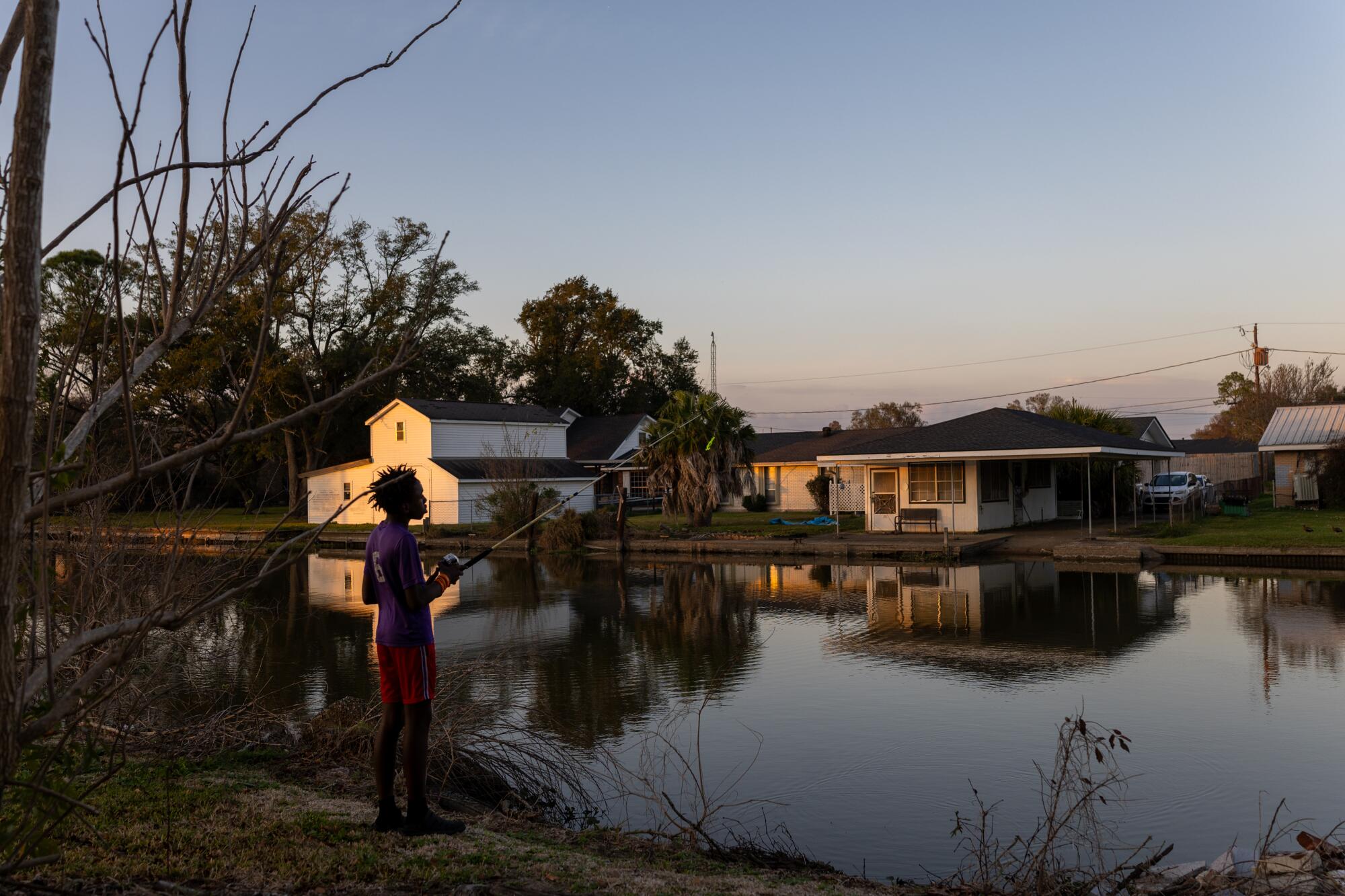
Latrevien Moultrie, 14, fishes in Houma, La.
Advertisement
“It’s affected everybody,” he said. “It’s not only the boats, the infrastructure, the packing plants. It’s the hardware stores. The fuel docks. The grocery stores.”
Two of the Blanchardses’ three children have moved away, seeking opportunity elsewhere. One daughter is a university law professor. Their son works in logistics for a trucking company in Georgia. Their other daughter, who lives near the couple, applies her advanced degree in school psychology as a stay-at-home mother of five.
(Cheri Blanchard, 64 and retired from the state labor department, keeps the books for her husband.)
It turns out the federal government is at least partly responsible for the shrinking of the domestic shrimp industry. In recent years, U.S. taxpayers have subsidized overseas shrimp farming to the tune of at least $195 million in development aid.
Seated at their dining room table, near a Christmas tree and other remnants of the holidays, Blanchard read from a set of scribbled notes — a Bible close at hand — as he and his wife decried the lax safety standards, labor abuses and environmental degradation associated with overseas shrimp farming.

James Blanchard and his wife, Cheri, like Trump’s policies. His personality is another thing.
Advertisement
The fact their taxes help support those practices is particularly galling.
“A slap in the face,” Blanchard called it.
::
Donald Trump grew slowly on the Blanchards.
The two are lifelong Republicans, but they voted for Trump in 2016 only because they considered him less bad than Hillary Clinton.
Once he took office, they were pleasantly surprised.
They had more money in their pockets. Inflation wasn’t an issue. Washington seemed less heavy-handed and intrusive. By the time Trump ran for reelection, the couple were fully on board and they happily voted for him again in 2024.

Republican National Committee reading material sits on the counter of James Blanchard’s kitchen.
Still, there are things that irk Blanchard. He doesn’t much care for Trump’s brash persona and can’t stand all the childish name-calling. For a long time, he couldn’t bear listening to Trump’s speeches.
“You didn’t ever really listen to many of Obama’s speeches,” Cheri interjected, and James allowed as how that was true.
“I liked his personality,” Blanchard said of the former Democratic president. “I liked his character. But I didn’t like his policies.”
It’s the opposite with Trump.
Unlike most politicians, Blanchard said, when Trump says he’ll do something he generally follows through.
Such as tightening border security.
“I have no issue at all with immigrants,” he said, as his wife nodded alongside. “I have an issue with illegal immigrants.” (She echoed Trump in blaming Renee Good for her death last week at the hands of an ICE agent.)
Advertisement
“I have sympathy for them as families,” Blanchard went on, but crossing the border doesn’t make someone a U.S. citizen. “If I go down the highway 70 miles an hour in that 30-mile-an-hour zone, guess what? I’m getting a ticket. ... Or if I get in that car and I’m drinking, guess what? They’re bringing me to jail. So what’s the difference?”
Between the two there isn’t much — apart from Trump’s “trolling,” as Cheri called it — they find fault with.
Blanchard hailed the lightning-strike capture and arrest of Venezuelan President Nicolás Maduro as another example of Trump doing and meaning exactly what he says.
“When Biden was in office, they had a $25-million bounty on [Maduro’s] head,” Blanchard said. “But apparently it was done knowing that it was never going to be enforced.”
More empty talk, he suggested.
Just like all those years of unfulfilled promises from politicians vowing to rein in foreign competition and revive America’s suffering shrimping industry.
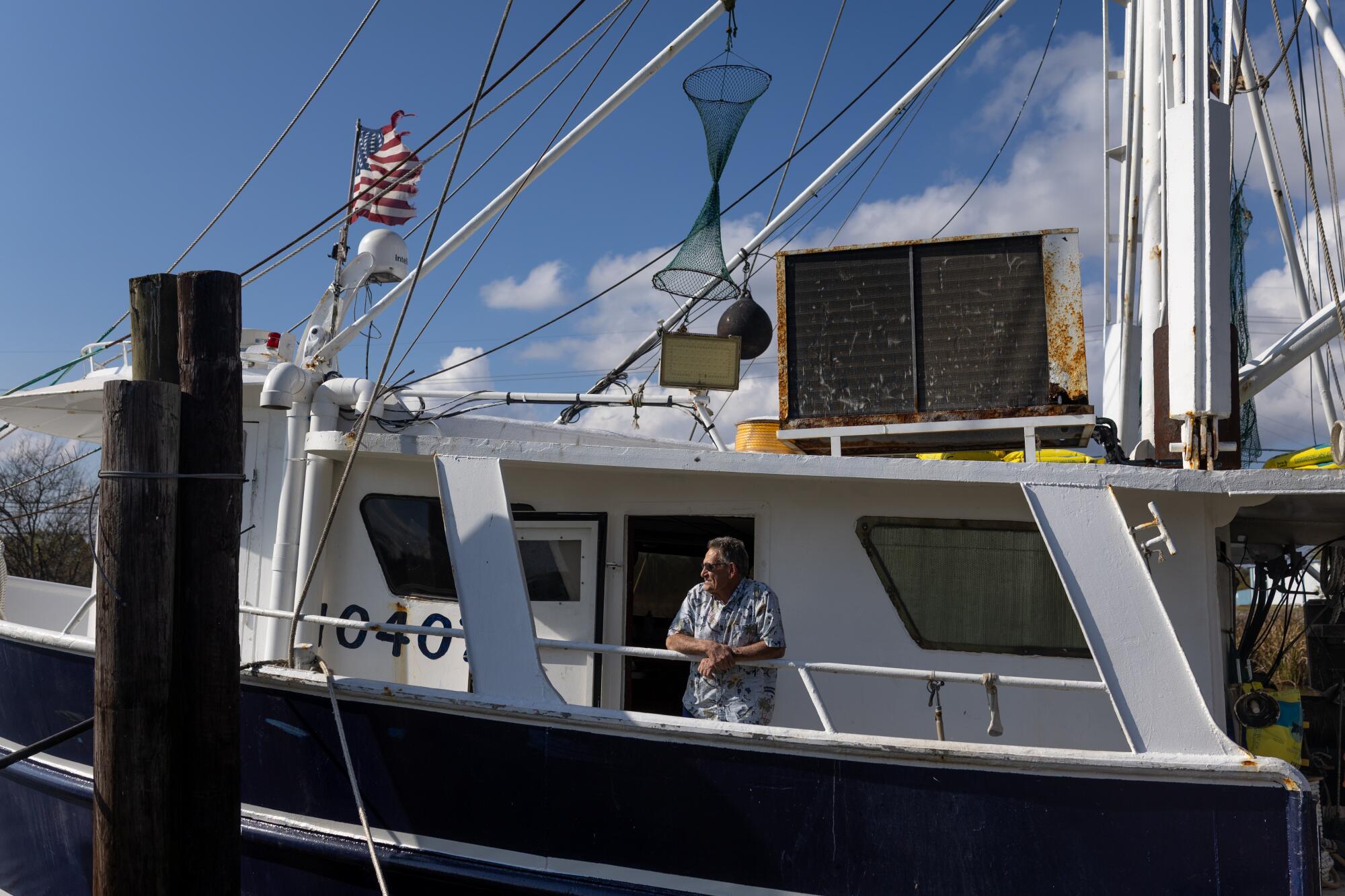
James Blanchard aboard his boat, which he docks in Bayou Little Caillou.
Advertisement
Trump and his tariffs have given Blanchard back his livelihood and for that alone he’s grateful.
There’s maintenance and repair work to be done on his boat — named Waymaker, to honor the Lord — before Blanchard musters his two-man crew and sets out from Bayou Little Caillou.
He can hardly wait.
More to Read
 Trump made many tariff threats in 2025. Here are some that didn’t materialize
Dec. 31, 2025
 Port workers navigate Trump’s unpredictable tariff policies
Dec. 23, 2025
 Why Trump’s tariff strategy could survive a Supreme Court defeat
Nov. 7, 2025
Insights
L.A. Times Insights delivers AI-generated analysis on Voices content to offer all points of view. Insights does not appear on any news articles.
Viewpoint
This article generally aligns with a
Center Right
point of view.
Learn more about this AI-generated analysisPerspectives
The following AI-generated content is powered by Perplexity. The Los Angeles Times editorial staff does not create or edit the content.
Ideas expressed in the piece
The author presents the perspective that Trump’s tariffs have provided essential relief to the struggling domestic shrimp industry after decades of decline. Tariffs imposed on major shrimp suppliers, growing from an initial 10% to 50% for Indian shrimp, have increased prices for wild-caught domestic shrimp from as low as 87 cents per pound to $1.50 or more, allowing shrimpers like the subject to continue operating rather than retire. The author emphasizes that this represents meaningful action, in contrast to years of unfulfilled political promises to address foreign competition. Additionally, the perspective highlights that the federal government has inadvertently undermined the domestic industry by subsidizing overseas shrimp farming to the tune of at least $195 million in development aid, while foreign suppliers rely on lax safety standards, labor abuses, and environmental degradation to produce cheaper shrimp. The author presents tariffs as the most effective tool to counteract these structural disadvantages and preserve American jobs and food security, with the subject noting that while legislative efforts are valuable, concrete tariff enforcement delivers tangible results where political rhetoric has long failed.
Different views on the topic
Critics of the tariffs argue they will create significant economic disruption and harm consumers. According to industry analysis, tariffs exceeding 40% on shrimp will likely be passed to consumers, making imports uncompetitive and inevitably reducing domestic shrimp consumption.[1] The tariffs are expected to trigger a period of heightened market volatility, with global rebalancing of trade routes creating oversupply in alternative markets and downward pressure on prices for producers worldwide.[1] These structural disruptions extend beyond shrimp, as tariffs of 75% on Chinese tilapia are expected to sharply reduce U.S. consumption of freshwater fish, while the threat of 25-35% tariffs on Canadian salmon poses operational challenges for salmon farmers and threatens the viability of regional farming investments.[1] Furthermore, the tariffs have prompted nearly 40 U.S. seafood companies to file legal challenges against the duties in federal court, arguing the measures are economically damaging.[3] Some industry participants acknowledge that while tariffs provide immediate relief, they are not a long-term solution, as tariffs remain subject to negotiation and the underlying issues of government subsidies supporting foreign aquaculture require more comprehensive reform beyond trade barriers.[2]